Adventures in a DIY Camper Van: Winter Woes and Wins
Ever dreamed of ditching rent and hitting the open road in your very own custom camper van? Sounds idyllic, right? But what happens when the romance of #vanlife meets the harsh reality of winter?
We've been living the dream (and sometimes the nightmare!) in our self-built 4x4 camper, and let me tell you, winter is the ultimate stress test. It exposes every little flaw and design oversight faster than you can say "condensation." Join us as we spill the beans on our latest modifications, mishaps, and monumental victories.
The Great Thermal Experiment: How Hot Does a Black Box Get?
Let's rewind to warmer days for a moment. We conducted a little experiment to see just how well (or not so well) our camper van's insulation was performing. With an outside temperature of a balmy 22°C, we measured the surface temperatures of our van after a full day in the sun.
Unsurprisingly, the black sections of the van hit a scorching 60°C! The gray panels were a slightly cooler 54°C, and the white parts managed to stay around 40°C. Inside, with all windows closed and no ventilation, the interior temperature climbed to 28°C. Now, some folks might expect a camper to magically be cooler than the outside air, but unless you've got some alien-tech insulation, that's just not how physics works! The ideal scenario, in our humble opinion, is for the interior temperature to match the ambient shaded temperature outside. Anything else is pure fantasy.
The Electrical Meltdown: When Your Inverter Decides to Go Rogue
Remember that trusty inverter, the one that converts 12V to 220V? Well, ours decided to stage a rebellion. It started sending rogue voltage spikes through the system, ranging from 13V all the way up to a terrifying 19V! This, as you can imagine, was not good news for anything with a microchip. We had appliances burning out left and right, and at one point, we even had a mini-fire scare!
This electrical drama didn't stop there. Our auxiliary heater, which is pretty crucial for winter living, also decided to pack up. Error code 10: "Blower motor not reaching required RPM." Cue frantic troubleshooting, replacing circuit boards, and eventually, ordering a whole new motor. The repair bill for the heater alone? A cool 14,000 rubles! And yes, a new inverter was also on the shopping list. This time, we splurged on a higher-quality, 3000W model, hoping to avoid future electrical infernos. It was a hefty investment, but some things you just can't skimp on, especially when your home on wheels is at stake.
The Silent Power Drain: Understanding Inverter Idle Consumption
One crucial, yet often overlooked, aspect of inverters is their idle current consumption. This is the power your inverter draws even when it's not actively powering anything. Our new, supposedly fancy inverter, turned out to be a bit of a power hog, draining about 1.5 to 2 amps per hour. Think about that: 24 to 48 amp-hours per day just for the inverter to sit there doing nothing! If you have a 50-60 amp-hour battery, that's a significant chunk of your power gone just like that.
This realization has prompted us to rethink our setup. We're now planning to convert our 220V refrigerator to run directly on 12V DC, eliminating the need to keep the inverter running constantly. This small change will drastically reduce our overall power consumption and help us stay off-grid for longer. It's a prime example of how even small inefficiencies can add up to big problems in a camper van.
Taming the Chaos: Drawer Latches and Unnecessary Handles
Those of you who warned us about drawers flying open on bumpy roads? You were absolutely right! The weight of our belongings, combined with the jostling of travel, meant our drawers were constantly popping open. Our solution? Simple childproof latches. They're discreet, effective, and keep our stuff securely in place.
On the flip side, some of our original design choices proved to be entirely superfluous. Those fancy handles on our cupboard doors? Totally unnecessary. Our lightweight doors and robust hinges mean they stay shut without any additional latching. We even removed some of the latches we initially installed, proving that sometimes, less is more when it comes to camper van design.
Suspension Shenanigans: A Quest for a Smoother Ride
Our camper van's rear suspension was, to put it mildly, a bit of a nightmare. It was overly stiff, unyielding, and every bump felt like a punch to the spine. The original setup included three thin and two thick leaf springs. With the addition of air springs, the weight distribution was off, and the air springs themselves were compressed too much.
Our solution, inspired by some clever suggestions, was to remove the two thick leaf springs. This would soften the ride and allow the air springs to extend more, providing a much-needed increase in suspension travel. To combat the increased body roll that might come with a softer suspension, we're also installing a GAZelle stabilizer bar. This is a budget-friendly and relatively simple modification, a "path of least resistance" if you will, compared to a full suspension overhaul. It’s all about finding that sweet spot between comfort and stability on the road!
The Air Spring Advantage: A Camper Van's Best Friend
Speaking of suspension, if your camper van has coil springs, you're in luck! Air springs are an absolute game-changer. For a minimal investment, you can adjust your suspension stiffness, lift your vehicle by several centimeters, and protect your suspension from bottoming out. They're easy to install, incredibly durable, and compatible with most vehicles. We've seen firsthand how they can transform a rough ride into a smooth cruise.
The beauty of air springs lies in their simplicity and effectiveness. Made from robust rubber, they can handle significant loads and operate in extreme temperatures. They reduce body roll and provide a more stable and predictable ride, especially when carrying a heavy load. If you're looking to improve your camper van's handling and comfort, air springs are definitely worth considering.
The Wobbly Module: Reinforcing the Connection to the Frame
One of our more alarming discoveries was the unexpected movement of our living module on the chassis. The module is rigidly attached at the rear but connected to the front of the vehicle's frame via a single, rather soft spring. This design allows for chassis flex during off-road driving, preventing the module from twisting and potentially breaking apart.
However, that soft spring proved to be a liability. During aggressive maneuvers, the module would visibly "jump" from the frame, creating a truly terrifying sensation and impacting vehicle handling. The thought of the module lifting on the outside of a turn was enough to send shivers down our spines. To address this, we've replaced the single soft spring with a much stiffer, dual-spring setup, using a robust spring from a Ural motorcycle fork. This significantly reduces the module's unwanted movement, ensuring a safer and more stable ride.
Battling Condensation: The Winter Nemesis
Living in a camper van in freezing temperatures inevitably brings one major challenge: condensation. We're currently residing in our van on our land, testing its winter readiness. Despite not having snow yet, the cold is definitely here, and so is the moisture.
We've tried various moisture absorbers, and while they collect a decent amount of water, they're not a magic bullet. Our humidity levels hover around 50%, jumping to 60% when we're cooking. Interestingly, we haven't noticed condensation on the van's main body, ceiling, or walls. The real culprit? Our factory-installed camper windows.
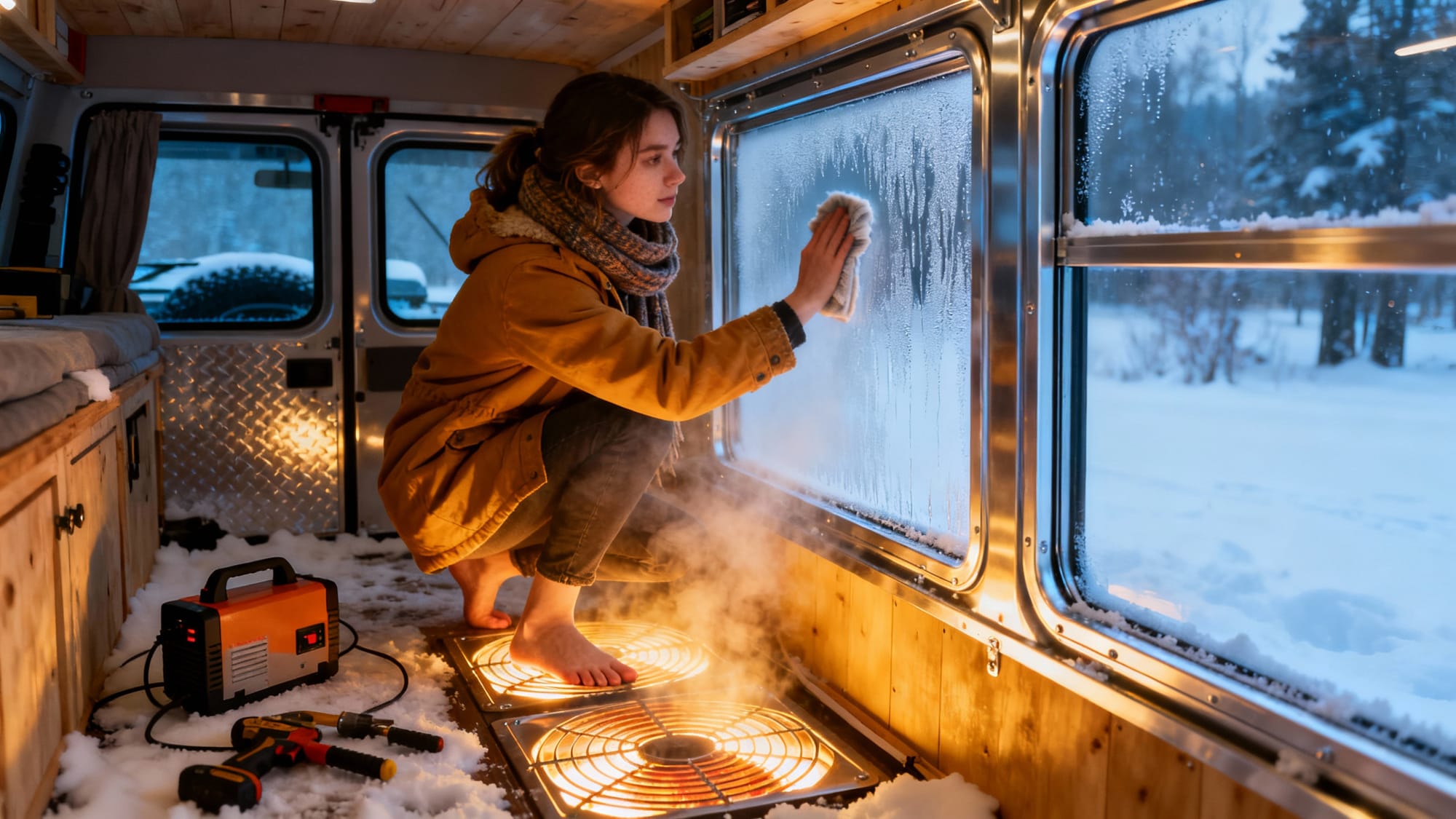
These double-glazed plastic windows have aluminum frames, which act as serious cold bridges. When the windows are open slightly for ventilation, the frames stay dry. But as soon as they're closed, water starts collecting on the frames and even on the window panes themselves. This is a stark reminder that even with good insulation, a cold bridge can undermine all your efforts. We'll need to devise a more permanent solution for next winter.
Table Troubles: The Quest for a Stable Surface
Our original camper table setup was, frankly, a pain. The two-legged system, while seemingly standard for campers, was wobbly, impractical, and a constant source of frustration. The legs had increasing amounts of play, making it impossible to enjoy a meal without fearing a soup-spilling disaster. To make matters worse, one leg was a screw-on design, while the other was a conical friction fit, making assembly and disassembly a tedious affair.
The aluminum base of the legs was also wearing down quickly, shedding aluminum shavings with every adjustment. Clearly, this wasn't built for the rigors of camper van life. Our solution came in the form of a more robust, folding table mechanism from China. This new system offers far greater stability and folds away easily, transforming our dining area into a comfortable sleeping space in a matter of seconds. It required a bit of welding to reinforce some weak points, but the improved stability is well worth the effort. Now, our table feels solid enough to withstand even the roughest roads!
The Heated Floor Revelation: A Game Changer for Winter Comfort
Now for some truly invaluable advice for anyone considering a winter-ready camper van: heated floor vents from your auxiliary heater are an absolute must! Our linoleum floor, while practical, is inherently cold. But with the heater vents strategically placed, sections of the floor become wonderfully warm. Imagine washing dishes or cooking barefoot, even when it's -3°C outside – pure bliss!
This simple modification not only provides incredible comfort but also contributes to better air circulation throughout the van. Our heater, located in a storage compartment, not only keeps that area warm (preventing mold) but also ensures that the seating area and even the kitchen cabinets receive a gentle flow of warm air. This constant air movement is crucial for preventing mold and mildew, especially in a compact living space.
Unforeseen Moisture Traps: The Moldy Truth
Despite our best efforts, we've identified two critical areas where moisture and potential mold growth are a concern. The first is behind our cushions, where the wall is cold on one side and warm on the other. This creates a perfect breeding ground for condensation and, eventually, mold. The temperature difference is significant, with the wall reaching as low as 11-13°C.
Our proposed solution involves creating a double wall with an air gap behind the cushions. This will allow warm air to circulate, preventing condensation and ensuring the wall remains dry. The second problem area is in the alcove, specifically where the mattress meets the cold outer wall. Despite our attempts to create airflow under the mattress, the contact points with the wall remain cold, leading to condensation and the potential for mold.
Solving this will likely involve a similar double-wall approach, ensuring air circulation in these critical areas. These aren't quick fixes and will require significant work, but addressing these issues is paramount for long-term comfort and health in a winter camper van. And a little tip for those choosing foam for cushions: avoid cheap, low-density foam! It deforms quickly and offers poor support. Invest in high-density foam that maintains its shape and provides proper firmness, even at thinner profiles.
Final Thoughts: The Ongoing Adventure
Building and living in a DIY camper van is an ongoing adventure, filled with both triumphs and challenges. Winter has been an invaluable teacher, highlighting areas for improvement and pushing us to find creative solutions. We're constantly learning, adapting, and refining our mobile home.
Stay tuned for more updates as we continue our journey, tackle new modifications, and explore the world in our unique 4x4 camper van. Every bump in the road (literal and metaphorical) is a learning opportunity, and we're excited to share it all with you!