PWM vs. MPPT: Choosing the Right Solar Controller for Your Van Life
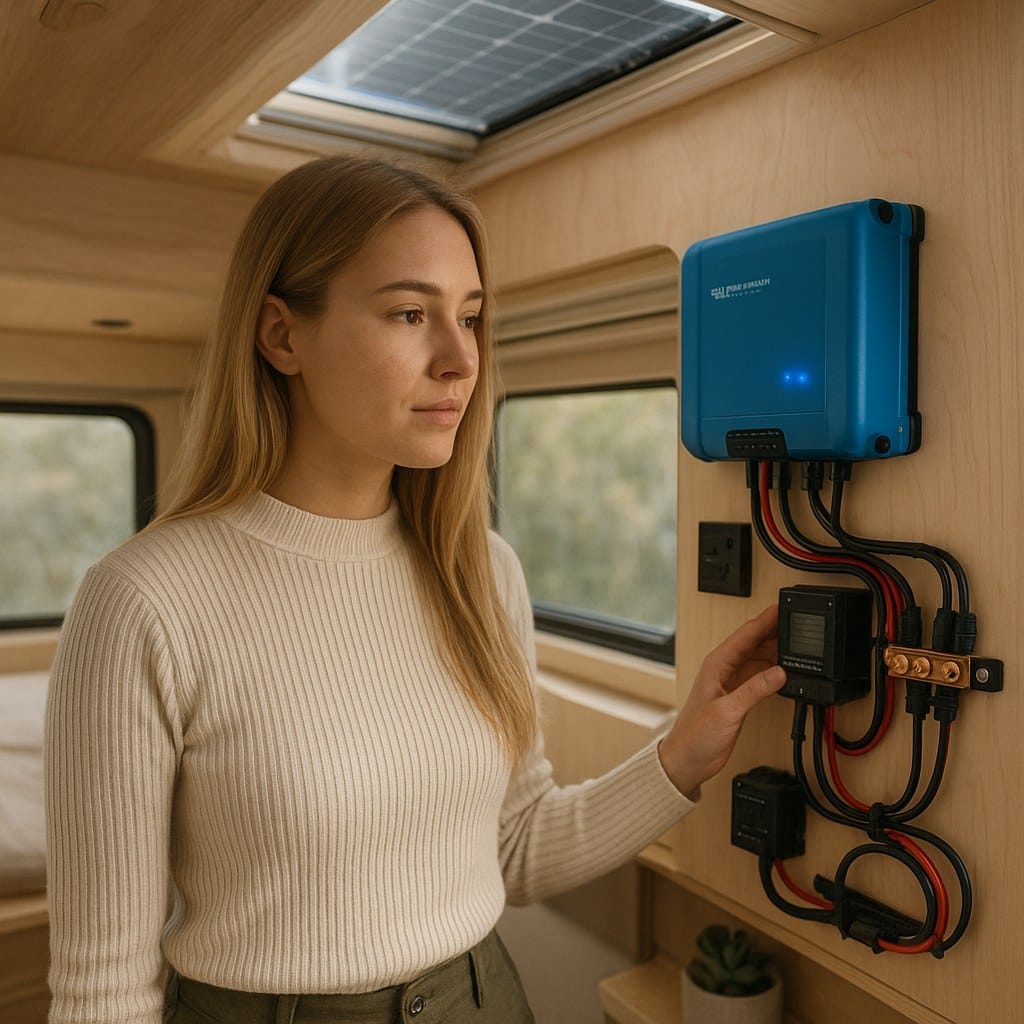
Have you ever wondered why you can't just plug a solar panel directly into a battery and call it a day? It seems like a simple enough connection, but doing so is a one-way ticket to a fried battery and a very expensive repair bill.
In the world of DIY motorhomes and off-grid living, the solar charge controller is the unsung hero that sits quietly between your roof-mounted panels and your energy storage. Today, we’re diving into the eternal debate of PWM versus MPPT to help you decide which "brain" your power system actually needs.
The Middleman: Why You Need a Controller
Think of a solar panel as a wild, unpredictable river. On a bright, cloudless day, the current is rushing with immense force; when a cloud passes over or the sun dips toward the horizon, that flow turns into a mere trickle. Batteries, on the other hand, are quite picky. They require a steady, regulated flow of energy to charge safely and efficiently.
If you connect a panel directly to a battery, the fluctuating voltage and amperage—especially the high spikes during peak sunlight—will eventually "kill" the battery's internal chemistry. A solar controller acts as a protective buffer, smoothing out these spikes and ensuring the battery receives exactly what it can handle. In the market today, you’ll find two primary technologies: the budget-friendly PWM and the high-tech MPPT.
PWM Controllers: The Budget-Friendly Workhorse
PWM stands for Pulse Width Modulation. These devices are the older, simpler cousins in the solar family. They are generally compact, lightweight, and very affordable. You can often find a decent PWM controller from a reputable brand for a fraction of the cost of its high-end counterparts.
How do they work? Imagine a rapid on-off switch. To keep the battery from overcharging, the PWM controller "flicks" the connection on and off thousands of times per second, reducing the average amount of energy reaching the battery. However, there is a catch: they aren't very "smart."
- Best for small systems: If you only have 100W or 200W of solar on your roof, a PWM controller is often perfectly adequate.
- Efficiency limits: They struggle significantly in overcast weather or during winter. When the sun is low and the panel’s efficiency drops, a PWM controller often fails to harvest any meaningful energy.
- The "Old Reliable": Interestingly, many high-end American factory-built motorhomes still come with PWM controllers because they are durable and "good enough" for basic needs.
MPPT Controllers: The Intelligent Powerhouse
If PWM is a simple switch, MPPT (Maximum Power Point Tracking) is a sophisticated computer. These units are larger, heavier, and significantly more expensive, but they earn their keep through sheer intelligence. An MPPT controller constantly monitors the voltage and current of your panels to find the "sweet spot" where they produce the most power.
The magic of MPPT lies in its ability to convert excess voltage into additional amperage. While a PWM controller simply "chops off" extra voltage (wasting it), the MPPT transforms it, meaning your battery charges faster even when conditions aren't perfect. This makes them absolute champions in the winter or on gray, rainy days when every drop of energy counts.
Market Tiers: From Budget to Luxury
When shopping for an MPPT, you’ll encounter several levels of quality. Brands like EPEVER or SmartWatt (formerly known as Delta) represent the "middle class" of controllers. They are reliable, well-tested, and offer great performance without a luxury price tag. If you want the absolute gold standard, you look toward brands like Victron Energy. Originally designed for the demanding world of yachting, their gear is incredibly robust, though the price reflects that premium heritage.
Wiring and Installation Strategy
Setting up these controllers is relatively straightforward, but there are some nuances in how you distribute that power. Both types feature terminals for your solar panels (plus/minus) and your battery (plus/minus). However, many MPPT controllers also include a third set of terminals labeled "Load" or "Output."
There are two main schools of thought on how to wire your 12V appliances:
- Direct to Battery: You connect all your lights, pumps, and fans to a fuse block that runs directly off the battery. This is the simplest method and the one most people choose to avoid confusion.
- Through the Controller: You connect your daytime loads (like a fridge or a phone charger) to the controller’s output. The benefit here is that during the day, the controller can feed power from the panels directly to your devices, bypassing the battery entirely. This can slightly extend your battery's lifespan by reducing charge cycles.
A pro tip for those using the second method: only connect devices you use while the sun is up. For things like interior lights or a evening television, it’s usually better to stick with a traditional battery-to-fuse-block setup.
Sizing Your Controller: Don't Overbuy!
It is a common mistake to think that "bigger is always better." In reality, buying a 60-amp MPPT controller for a tiny 200W solar array is a waste of money. Not only does the price of these units jump significantly as the amperage rating increases, but larger controllers also consume more energy just to keep their own internal electronics running (known as "idle draw").
To find your ideal size, use a bit of simple math. Take the total wattage of your solar panels and divide it by your battery voltage (usually 12V or 24V). For example, 400W of solar divided by 12V equals roughly 33 amps. In this case, a 40-amp controller is your perfect match. There is no need to spend double on a 60-amp unit that you’ll never fully utilize.
Final Verdict: Which One Should You Buy?
So, after all the technical jargon, which one wins? The answer depends entirely on your goals and your wallet. If you are building a budget weekender with one small panel and you only travel in the summer, a PWM controller will save you money that you can spend on fuel or better snacks for the road.
However, if you plan on living in your van full-time, or if you enjoy camping during the colder, gloomier months, an MPPT controller is non-negotiable. It is an investment in your independence, ensuring that even a weak winter sun provides enough juice to keep your lights on. While the upfront cost is higher, the efficiency gains in "real world" conditions make it the superior choice for any serious traveler.
Whichever path you choose, remember that the controller is the heart of your electrical system. Treat it well, size it correctly, and it will keep your batteries healthy for years of adventures to come!
Video
